


How to Collect a Symptom Picture in Homeopathy
Updated: May 15
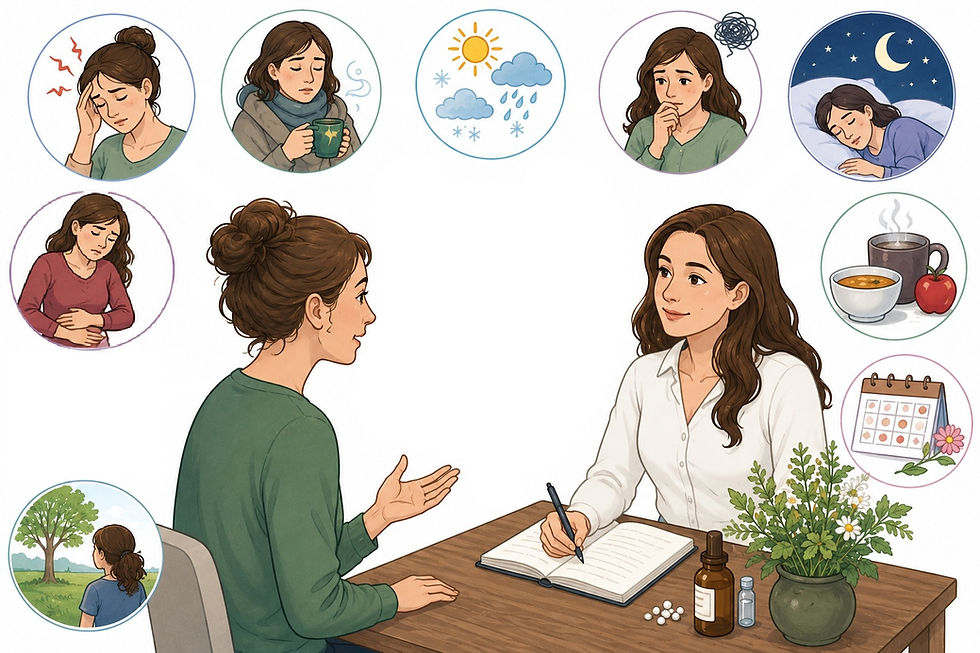
Homeopathy is extremely individualized medicine. It does not treat a diagnosis or disease label, but the person experiencing it. Two people with migraines, eczema or anxiety may need completely different remedies because the way they experience those symptoms is different.
That is why homeopaths ask so many questions. We are not simply collecting a list of symptoms. We are trying to understand the pattern of the person as a whole. “Sometimes a tiny detail becomes the key that individualizes the case.
In chronic care especially, this requires detailed information about the person's whole history, including physical symptoms, emotional state, sensitivities, energy, sleep, digestion, childhood and more (see my post on acute vs. chronic care).
One of the most helpful things a client can learn is how to tune into their bodily sensations and to observe and describe their symptoms clearly. The more complete and specific the symptom picture, the easier it is for a homeopath to find an appropriate remedy.
This post is meant to help clients understand the importance of tuning into the body and communicate symptoms in a more complete way.
Why details matter in homeopathy
A homeopath is not only interested in what symptom is happening, but how it happens.
For example, saying:
“I have a headache.”
is usually not enough information to differentiate between remedies.
But saying:
“I have a throbbing headache over my right eye that gets worse from sunlight and better from pressure and lying in a dark room”
gives far more useful information.
The details are often what individualize the symptom.
How a homeopath collects the symptom picture
When analyzing a symptom, a homeopath often gathers information using a framework sometimes referred to as CLAMS:
Concomitants
What other symptoms appeared along with it?
These are symptoms that began around the same time and may seem unrelated, but are often very important in homeopathy.
For example:
nausea with a headache
irritability during a fever
diarrhea accompanying a cough
chills with anxiety
Location
Where exactly is the symptom located? Does the location change or move around?
For example:
left side or right side
above the eye
deep in the joint
radiating downward
extending upwards
fingertips vs. whole hand
The exact location matters.
Aetiology
What was happening when the symptom first appeared?
Sometimes the cause or trigger gives important clues.
For example:
after grief
after a head injury
after getting chilled
after overexertion
after a stressful event
after lack of sleep
Modalities
What makes the symptom better or worse?
This is one of the most important parts of homeopathic case-taking.
Many remedies are differentiated primarily by their modalities.
Sensation
How does it feel?
Even unusual descriptions can be useful. Many homeopaths go deeply into the sensations, the inner experience of the person, to find a remedy match.
For example:
burning
throbbing
stabbing
cramping
pulling
tight
bruised
raw
tingling
it feels like something is....
it feels like someone is...
Common modalities homeopaths look for
Temperature
Does the symptom change with heat or cold?
For example:
better from warmth
worse from heat
better from cold applications
worse after getting chilled
better in fresh air
worse in stuffy rooms
worse in the sun
better near a heat source
worse from cold drinks
better from warm drinks
Motion
Does movement affect the symptom?
For example:
worse from walking
better from gentle movement
worse from the slightest motion
worse from turning the head
worse from bending or stooping
better lying still
worse riding in a car
worse from movement of the affected limb
better from movement of the whole body
Other things that may aggravate or ameliorate symptoms
Homeopaths may also ask about:
time of day
weather changes
emotional state
before or after eating
before or after bowel movements
menstruation or ovulation
sleep
specific foods or drinks
stress
exertion
touch or pressure
Sometimes a very small detail ends up being highly characteristic.
Acute care vs. chronic care
As discussed in my post on acute vs. chronic care, acute prescribing and chronic prescribing are approached differently.
In acute care, the focus is primarily on:
the main symptom
what changed since the acute illness began
the onset of symptoms
concomitant symptoms
modalities
sensations
For example, during a flu, food poisoning, injury or sudden illness, the goal is to understand the acute state as clearly as possible.
In chronic care, the chief complaint must still be analyzed in detail, but the case is much broader. The homeopath is also trying to understand the person’s general constitution and long-term pattern of imbalance.
This may include questions about:
sleep
energy
digestion
menstruation
libido
mood
fears and anxieties
food cravings and aversions
sensitivities and triggers
childhood history
traumas
family history
past illnesses
medical history
personality patterns
and much more.
The goal is to understand the person as a whole, not just isolated symptoms.
An example case
From Adolph Lippe, MD
This case demonstrates how homeopathy individualizes a case beyond simply naming the diagnosis. A coach horse developed sudden diarrhea after being driven for an hour on the first hot day of April. The diarrhea was profuse, watery and offensive, becoming much worse from motion during the drive, but stopping completely once the horse was back in the stable and at rest. Along with the diarrhea, the horse became extremely lethargic, stood with drooping eyelids, refused food, and showed a marked aversion to movement. These individualizing details — the clear aggravation from motion, amelioration from rest, worsening from heat, complete lack of appetite, and overall sluggish state — pointed strongly toward Bryonia. After a single dose, the horse lay down that night, ate his food the next morning and fully recovered by the third day. This case illustrates how homeopathy relies not only on the main complaint, but on the modalities, concomitant symptoms, causation and overall pattern of the case.
Learning to observe yourself
Many people are not used to paying close attention to their symptoms until they begin working with a homeopath. That is completely normal.
Over time, clients often become much more aware of:
patterns in their health
triggers
changes in energy and mood
reactions to weather, food or stress
the sequence of symptoms
This awareness can greatly improve the quality of a homeopathic case.
You do not need to analyze yourself perfectly. You simply need to observe honestly and describe your experience as clearly as you can.
Often, the smallest detail can help illuminate the larger pattern.

Understanding Acute vs Chronic Prescribing in Homeopathy here
Understanding Holistic Health & Homeopathy: the Tree Analogy here
What To Expect from Your Initial Consultation here.


Comments